Small apartments rarely suffer from a lack of light. They suffer from too many lights doing the same job. A ceiling fixture in the middle of the room, a floor lamp squeezed between the sofa and the bookcase, a table lamp on a sideboard that hasn't been switched on since the clocks changed — each one takes up space, and together they make a compact room feel busier than it actually is. The fix isn't more fixtures. It's fewer, better-placed ones: wall lights that lift light off the floor, one or two slim floor lamps used with intent, and small pools of light that let the rest of the room fall gently into shadow.
Start with why a small room feels crowded
A single central light does two unhelpful things at once. It flattens the room into one bright plane, so every object carries the same visual weight, and it leaves the corners darker than the centre. Your eye reads that contrast as clutter: furniture edges appear to pile up because there is no shadow to separate them.
Move the light to the edges, vary its height, and the same furniture starts to breathe. Uplight a dark corner and the ceiling feels higher. Wash a wall with light and the room appears wider, because the eye reads a lit surface as extra depth. Keep the middle of the room softly dim and the gaps between things become visible again. That is the whole principle. Everything below is application.
Wall lights: let the walls carry the load
Sconces are the least appreciated tool in a compact flat. They occupy no floor space, they free the surfaces you would otherwise fill with table lamps, and they put light where a ceiling fixture cannot — at the height of a seated person, aimed across the room rather than down onto the carpet.
Where they earn their place
- Either side of a sofa, roughly 1.5m to 1.7m from the floor, so the light meets you at shoulder height while you read instead of casting a shadow over your page.
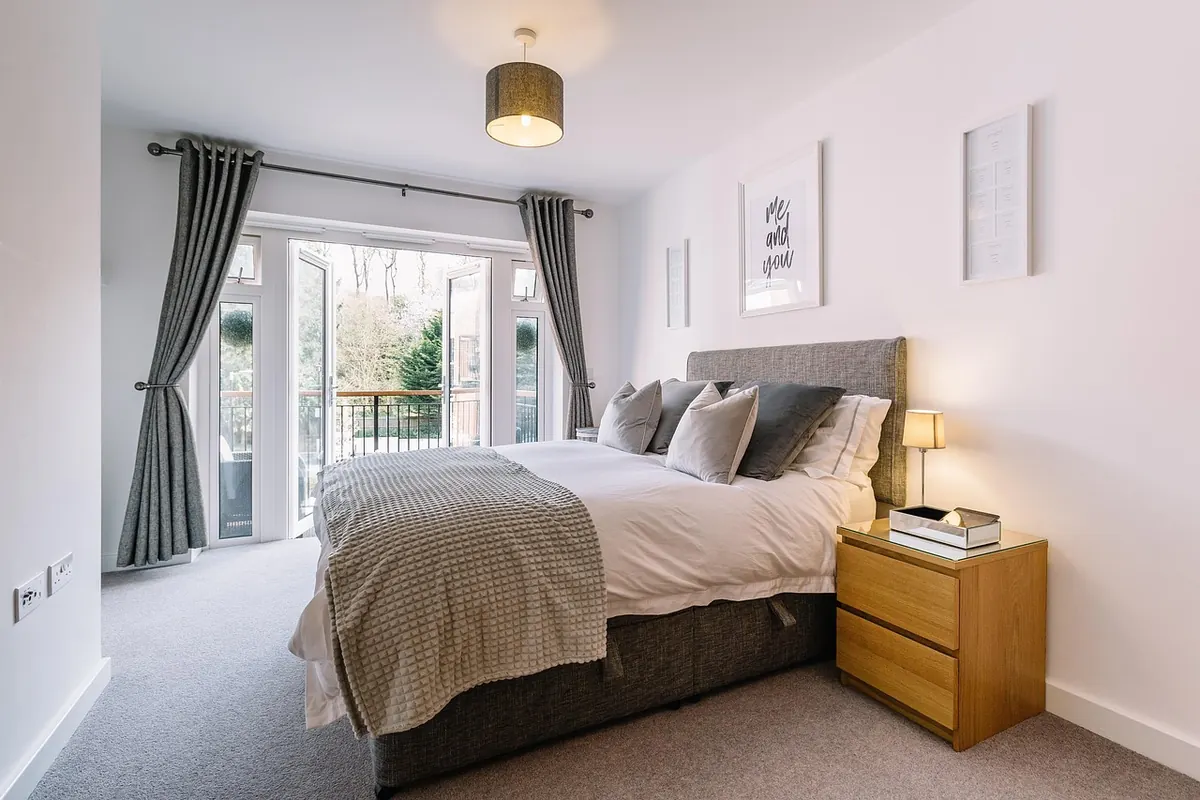
- Beside a bed, at around 1.1m to 1.2m, with a swing arm or a small tilting shade. Two sconces replace two bedside lamps and hand back the entire top of the nightstand.
- Over a kitchen worktop or a slim console, washing the surface below rather than throwing light into the room.
- Down a hallway, where a pair spaced evenly along one wall reads as architecture and keeps the ceiling completely clear.
- Above a picture or a small shelf, with a slim picture light that gives the eye somewhere to land.
If you rent, plug-in sconces solve the wiring problem without an electrician: the cord runs down the wall to the nearest socket. Route it straight, clip it neatly, or hide it behind a slim cover matched to the skirting. Choose a shade or a design that conceals the bulb — a bare lamp at eye level is the quickest way to make a considered room feel unfinished.
Floor lamps: one good one beats three timid ones
Small rooms collect floor lamps the way kitchens collect gadgets. A better rule is to decide what each lamp is actually for, then buy one that does only that. A corner uplighter should be tall and slim, throwing light at the ceiling to lift the darkest part of the room; something around 1.6m to 1.8m tall with a narrow head does the job without eating floor space. A reading lamp should reach over your chair, not sit at knee height glowing into nothing.
Cords count as clutter. Route them behind furniture, run them along the skirting rather than diagonally across the floor, and don't be afraid of a fabric-covered cord you are happy to see. If you can only budget for one lamp this month, spend it on the corner that currently looks like a dead end. That single change often does more for a small living room than a whole new arrangement of furniture.
Pools of light make a room feel larger
It sounds backwards, but brightness everywhere shrinks a room; a few bright pools set against softer surroundings expand it. Contrast is how the eye judges depth. A room lit evenly at 300 lux from a single source reads as flat and slightly airless. The same room with a warm pool over the dining table, a wash on one wall and a dim corner behind the sofa reads as layered, and layers read as space.
To build those pools, control the beam. Shades that are opaque on the outside and pale inside push light down onto a surface instead of into your eyeline. Recessed adjustable spots, angled towards a wall or a shelf, give you a defined patch of light rather than a general glow. Aim for warm white lamps — around 2700K to 3000K — and pick high-colour-rendering bulbs so wood, fabric and skin don't turn grey. Then add dimming wherever you can: an inline dimmer on a lamp, a dimmable bulb on a smart plug, or a proper dimmer switch if the wiring allows. Being able to drop the light in the evening is what turns three pools of light into an atmosphere rather than a lighting plan.
A layering plan for a compact flat
- Turn off the ceiling light for a week. Notice which corners go dark and which tasks become difficult. That tells you what you actually need.
- Place light at three heights: low (a lamp on a side table), middle (sconces, a worktop light), high (a corner uplighter or a wall washer). Three heights in one room immediately create depth.
- Give each fitting one job — reading, dining, washing a wall, lighting a picture. If a lamp has no job, it is furniture, not lighting.
- Dim everything you can, and keep the brightest pool where you sit or work.
- Hide the hardware: cords, adaptors, exposed bulbs. Clutter is often just visible technology.
Mistakes that quietly add clutter
Three fittings lined up at the same height along one wall create a visual shelf of lampshades; stagger them instead. Cool white bulbs in a small living room make every surface look harder and smaller. Lighting the centre of the room rather than its edges leaves the walls dull and the floor crowded. And over-lighting is its own kind of mess: if you can see every corner clearly at once, nothing in the room has anywhere to recede to.
Start with one corner tonight
Pick the corner you avoid. Move the floor lamp there, angle it at the ceiling, switch off the overhead light and see what the room does. Then add a sconce or a small lamp at seated height beside your favourite chair, put both on a dimmer, and live with it for a week before buying anything else.
Good lighting in a small apartment is mostly an exercise in restraint: fewer sources, each with a clear purpose, aimed at the surfaces that deserve attention. Do that and the room stops feeling tight. It starts feeling composed.
Photo: StuBaileyPhoto / Pixabay